Integrating Design Tools Vector Thin Line Icons Set into Professional Workflows
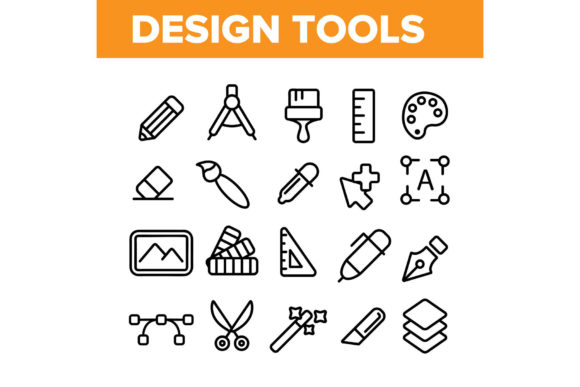
In the fast-paced world of digital creation, visual consistency is not merely an aesthetic preference; it is a functional necessity. Whether you are building a mobile application, designing a corporate presentation, or curating content for a marketing campaign, the symbols you choose communicate information faster than text ever could. This is where the Design Tools Vector Thin Line Icons Set becomes an essential asset for modern creators. These graphic design tools, painting, and sketching accessories linear pictograms offer a streamlined way to represent complex creative processes without adding visual clutter.
For professionals ranging from freelance illustrators to enterprise-level marketers, understanding how to effectively deploy these assets can significantly enhance workflow efficiency. The value of this collection lies not just in the individual images of drawing equipment, brushes, pencils, and image editing instruments, but in how they integrate into a broader design ecosystem. By utilizing contour illustrations that are lightweight and scalable, designers can maintain high-quality visuals across various platforms while reducing load times and development overhead.
The Role of Linear Pictograms in Modern UI and Content Strategy
Thin line icons have surged in popularity due to their minimalist appeal and versatility. Unlike filled or solid icons, linear pictograms rely on negative space and precise stroke weights to convey meaning. This makes them particularly effective in user interfaces where screen real estate is limited, or in printed materials where a subtle, sophisticated look is desired. The Design Tools Vector Thin Line Icons Set specifically targets the creative industry, providing immediate visual cues for activities related to art, design, and digital media production.
When incorporating these icons into a project, it is crucial to consider the context. For instance, a blog post about digital painting techniques benefits immensely from accompanying visuals of styluses and palettes. Similarly, a software tutorial for image editing instruments becomes more intuitive when users can quickly identify toolbar functions through recognizable contour illustrations. The key is consistency. Using a cohesive set ensures that the visual language remains uniform, reinforcing brand identity and improving user comprehension.
Workflow Integration: Before, During, and After Production
Implementing a new asset library requires a strategic approach. The utility of the Design Tools Vector Thin Line Icons Set extends across the entire lifecycle of a creative project. Understanding where these assets fit into your planning and execution phases can maximize their impact.
Pre-Production and Planning
During the initial stages of a project, such as wireframing or storyboarding, these icons serve as excellent placeholders. Because they are vector-based, they can be scaled infinitely without losing quality, allowing designers to experiment with layout structures without committing to final high-resolution raster images. Using standard symbols for brushes, pencils, and other drawing equipment helps stakeholders visualize the intended functionality of an app or the structure of a guide before heavy coding or writing begins.
Furthermore, having a pre-made set of graphic design tools accelerates the mood-boarding process. Instead of searching for disparate images online, which often results in inconsistent styles, you can pull directly from the Design Tools Vector Thin Line Icons Set to create a unified visual direction. This preparation phase saves considerable time later, as the foundational visual elements are already selected and approved.
Active Development and Design
As the project moves into active development, the compatibility of file formats becomes paramount. This icon set is available in JPG, EPS, AI, PSD, and PNG formats, offering flexibility for different teams and software environments. Web developers might prefer SVG or PNG for quick implementation, while UI designers working in Adobe Illustrator or Photoshop will find the AI and PSD files invaluable for customization.
The ability to edit these vectors is a significant advantage. You may need to adjust the stroke width to match your brand’s specific design system or change the color to align with a dark mode interface. With the source files in AI or EPS format, these adjustments are non-destructive and straightforward. This level of control ensures that the painting and sketching accessories linear pictograms do not look like generic clip art but rather like bespoke elements tailored to your specific product.
Post-Production and Maintenance
After launch, the work is not done. Digital products require updates, and marketing materials need refreshing. Having a centralized library of Design Tools Vector Thin Line Icons Set assets simplifies long-term maintenance. If you need to add a new feature related to image editing instruments, you can quickly locate the corresponding icon in your library, ensure it matches the existing style, and deploy it. This reduces the risk of "design drift," where new elements inadvertently deviate from the established visual language.
Technical Considerations and File Format Usage
To fully leverage the potential of this icon set, one must understand the strengths of each provided format. Choosing the wrong format can lead to pixelation, excessive file sizes, or editing difficulties.
- AI and EPS: These are the master files. Use them when you need to modify the shape, combine paths, or resize the icons for large-format printing. They preserve the mathematical precision of the vector paths, ensuring crisp edges at any scale.
- PSD: Ideal for designers who work primarily in Photoshop. These files often come with organized layers, making it easy to toggle visibility, apply layer styles, or integrate the icons into complex compositions involving photos and textures.
- PNG: Best for web use when transparency is required. While not scalable like vectors, PNGs are universally supported and easy to implement in HTML/CSS. Ensure you export at the correct resolution (usually 2x or 3x for retina displays) to maintain clarity.
- JPG: Suitable for contexts where transparency is not needed and file size is a concern, though less common for icons due to the lack of alpha channels. Use this for background elements or when embedding icons in documents where vector support is limited.
By organizing these files logically within your project folders, you create a efficient retrieval system. Tagging files with relevant keywords such as "brush," "pencil," or "vector" can further speed up the search process, especially in larger teams where multiple people access the assets.
Ensuring Visual Consistency and Quality Control
One of the most common pitfalls in design is mixing icon styles. Combining thin line icons with filled icons or hand-drawn sketches can create a disjointed user experience. The Design Tools Vector Thin Line Icons Set provides a solution by offering a comprehensive range of related imagery under a single stylistic umbrella. However, it is still up to the designer to enforce consistency.
Pay attention to stroke weights. If your interface uses a 2px stroke for navigation icons, ensure the drawing equipment contour illustrations match this weight. Most vector editing software allows you to globally adjust stroke properties, but manual verification is often necessary for complex paths. Additionally, consider the corner radius. Rounded caps and joins often feel friendlier and more modern, while sharp corners convey precision and technicality. Align these details with your overall brand personality.
Accessibility is another critical factor. Ensure that the contrast between the icon lines and the background meets WCAG guidelines. Thin lines can sometimes disappear against busy backgrounds or fail to meet contrast ratios on light gray interfaces. In such cases, increasing the stroke weight slightly or adding a subtle drop shadow can improve visibility without compromising the minimalist aesthetic.
Practical Applications Across Industries
The versatility of this icon set allows it to serve various professional needs. Educators creating online courses about art history or digital design can use these pictograms to break up text-heavy modules, making the content more engaging and easier to scan. Bloggers and publishers can use them as custom bullet points or section headers, adding a professional touch to their articles without the need for custom illustration commissions.
For entrepreneurs and small business owners launching creative services, these icons provide a cost-effective way to build a polished brand presence. From business cards to social media graphics, the consistent use of high-quality vector assets signals professionalism and attention to detail. Freelancers can also include these icons in their portfolios to visually represent their skill sets, using the brush and pencil symbols to denote creative capabilities clearly and concisely.
Ultimately, the Design Tools Vector Thin Line Icons Set is more than just a collection of images; it is a toolkit for clearer communication. By integrating these assets thoughtfully into your workflow, respecting technical constraints, and maintaining visual consistency, you elevate the quality of your output. Whether you are sketching out the next big app idea or refining the final details of a marketing deck, these linear pictograms provide the structural support needed to bring your creative vision to life efficiently and effectively.